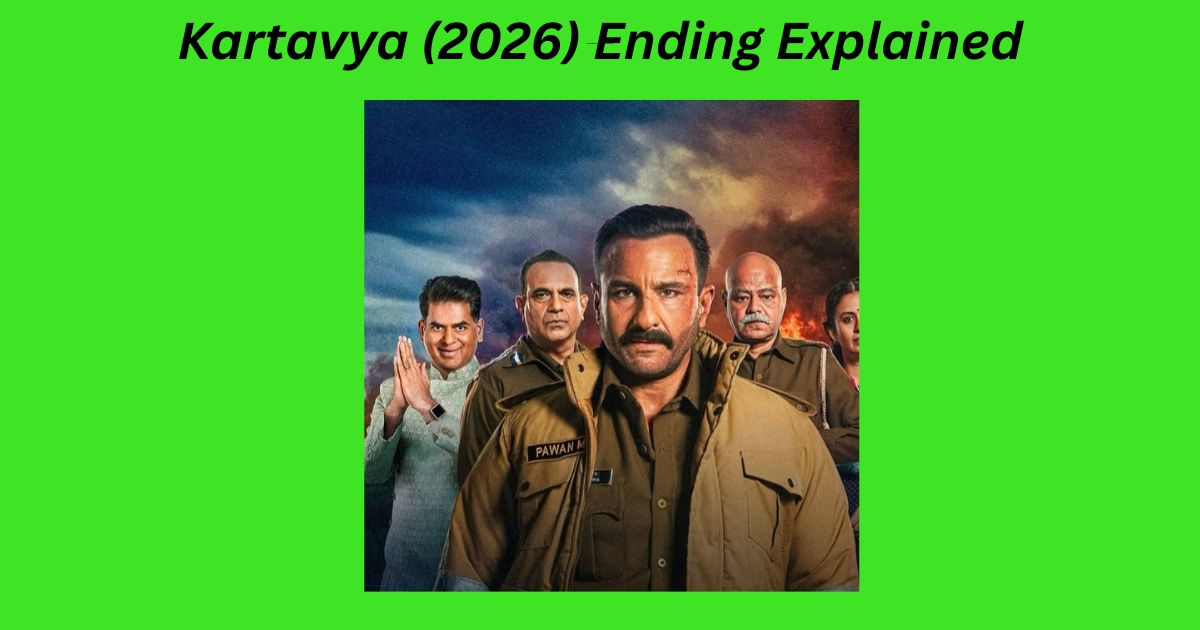
Kartavya (2026) Ending Explained — When Duty Costs You Everything
Kartavya (2026) Ending Explained Okay so. I just finished watching Kartavya on Netflix and I genuinely sat with the ending screen for five whole minutes, just staring. Not because I was confused. Because I needed a moment. This film does something to you quietly, almost sneakily and by the time you realize how deep it’s gone, it’s already too late to protect yourself from it.
If you’re here looking for a simple answer to what happened in the ending, I’ll give you that. But honestly? The real ending of Kartavya isn’t just about what Pawan does. It’s about what it costs him. And that’s the conversation I really wanna have.
The Story, Quickly (For Those Who Need a Refresher)
begins on Pawan Malik’s 40th birthday. He’s the SHO of Jhamli a small, dusty North Indian town where everyone knows everyone, which is exactly the kind of place where corruption grows roots nobody can see.
Pawan is assigned to lead the security detail for an esteemed journalist. He doesn’t take it too seriously… until two people on a bike ride up and assassinate her in cold blood right in front of him. And just like that, his quiet small-town existence explodes.
What follows is Pawan trying to unravel who gave the order and the answer keeps pulling him deeper and deeper into something he really wasn’t ready for. Corrupt politicians. A shady godman named Anand Shri whose cult controls the region. A trusted partner who turns out to be a traitor. And at the very center of it all his own father.
Meanwhile, Pawan’s younger brother Deepak has fallen in love with a Dalit woman named Preeti and secretly married her. Pawan quietly tries to protect them setting Deepak up in a new home and giving him enough money to start a fresh life. He thinks he’s bought them time. He hasn’t.
The Ending — The Part That Broke Me
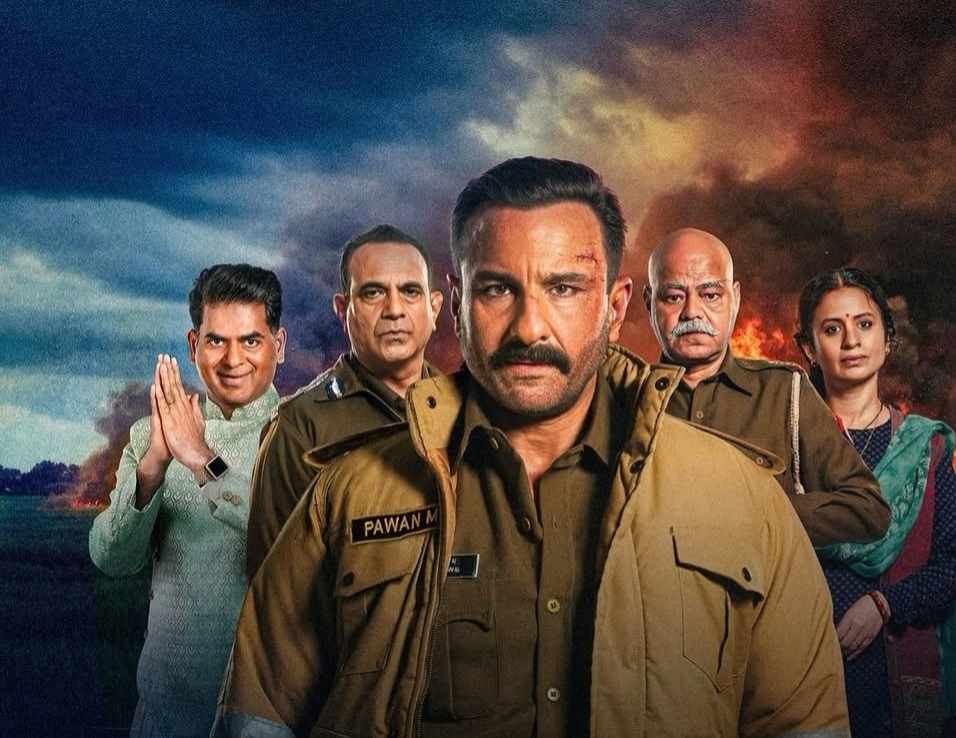
Here’s where the film stops being a crime thriller and becomes something far more painful.
Pawan learns while confronting his own colleague Ashok that his father Harihar had brutally killed Deepak, with Preeti likely meeting a similar fate at the hands of her own family. An honor killing. His little brother. Gone.
And something in Pawan just… breaks. You can see it in Saif Ali Khan’s performance. No crying. No rage. Just this horrible stillness. Like a man watching the last light go out.
That same night, Pawan takes Harihar out to an abandoned field and kills him in cold blood. His own father. And then in a detail that hits harder than any action sequence ever could he sets the body on fire.
The closing sequence shows Pawan sitting alone in his locked police jeep, staring at his badge in complete silence. No triumphant background score. No slow claps. Just a man who upheld the law, lost his family, and now has to live inside that silence forever.
The Hidden Meanings — This Film is Basically the Mahabharata in Disguise
Alright, here’s the part I think most people miss. The title isn’t just a cool word. It’s the entire thesis.
Pawan’s journey directly mirrors Arjuna’s dilemma at Kurukshetra a warrior who had to fight and kill Dronacharya, the teacher he revered, to avenge his son’s death. In a state of extreme internal conflict, Arjuna needed Krishna to tell him: forget your relationships, forget your grief, and focus only on your dharma your
That’s exactly what Pawan does. He has no Krishna. No divine guide. Just his own fractured conscience. And he still chooses duty.
The white sneakers his colleagues gift him at the beginning remember those? That’s not a throwaway detail. White in Indian symbolism represents purity, new beginnings. By the end, those sneakers are symbolic ghosts of a man who used to have simple, clean dreams. A birthday. A gift. A life not yet ruined.
The village setting itself is symbolic. The village community permanently exiles Pawan, leaving him an absolute outsider within his own bloodline. He becomes a man without a village, without a family, without belonging. The law gave him purpose but took away his home.
The Ashok Betrayal — Rewatch Moment
Though Ashok’s betrayal of Pawan is built up as the grand twist, details from earlier in the film already hint at it. One of the earliest scenes shows Ashok putting on his arm sling even though he doesn’t need it evoking sympathy, manipulating Pawan into seeing him as harmless. Every moment Ashok cautioned Pawan about risks, every time he let suspects slip away it was deliberate.
What makes it devastating isn’t the betrayal itself. It’s that Pawan had confided in Ashok about his brother’s situation. His most private fear. Ashok weaponized that trust. That’s the real violence of the film not the gunshots, but the quiet, intimate betrayals that made them necessary.
What the Film is Really Saying
isn’t really a cop drama. It’s a meditation on what happens when the institutions meant to protect people are rotten from the inside and the only person trying to fix it is also the person with the most to lose.
The ending emphasizes that duty involves sacrifice. Pawan seems emotionally exhausted but has gained a kind of self-realisation a terrible, costly clarity.
The film doesn’t celebrate him. That’s important. It doesn’t say what Pawan did was right. Killing your own father? Burning his body? That’s not heroism. That’s a man who ran out of other options in a world that gave him none. The film holds all of that complexity without flinching.
Anand Shri’s arc ends ambiguously the last we see of him is on a frantic phone call, trying to contain the fallout. His arrest isn’t confirmed, but the testimony against him has reached official records, triggering a process that’s no longer in his control. Justice in this film doesn’t arrive loudly. It tiptoes in.
My Personal Take — The Film Won’t Let You Off Easy
What I respect most about is that it refuses to make Pawan a hero. He’s a good man doing terrible things for arguably right reasons. The film asks: is that enough? And it doesn’t answer. It just shows you his face in that jeep, staring at a badge, and leaves you to sit with the question.
Saif Ali Khan is genuinely subdued and brilliant here. No over-acting. No dramatic dialogues. Just a quiet disintegration. That restraint is what makes the ending land so hard.
FAQ — Kartavya Ending Explained
Q: Does Pawan get arrested for killing his father? The film leaves this deliberately ambiguous. He drives away in his jeep. No consequences are shown but none are resolved either.
Q: Is Anand Shri arrested in the end? Not confirmed. But Harpal’s testimony entering the official registry sets a domino effect in motion that the godman can no longer stop.
Q: Why does Pawan burn his father’s body? It’s the final severance. Fire in Hindu tradition signifies both purification and finality. Pawan isn’t just ending a life he’s erasing a lineage of caste-based violence.
Q: Is there a sequel planned? No. The creative team confirmed was designed from inception as a self-contained, closed-ended character study.
Q: Where can I watch Kartavya? It’s streaming on Netflix globally.
Q: What does “kartavya” actually mean? Duty. Moral and spiritual obligation. The kind that costs you everything and demands you pay it anyway.
