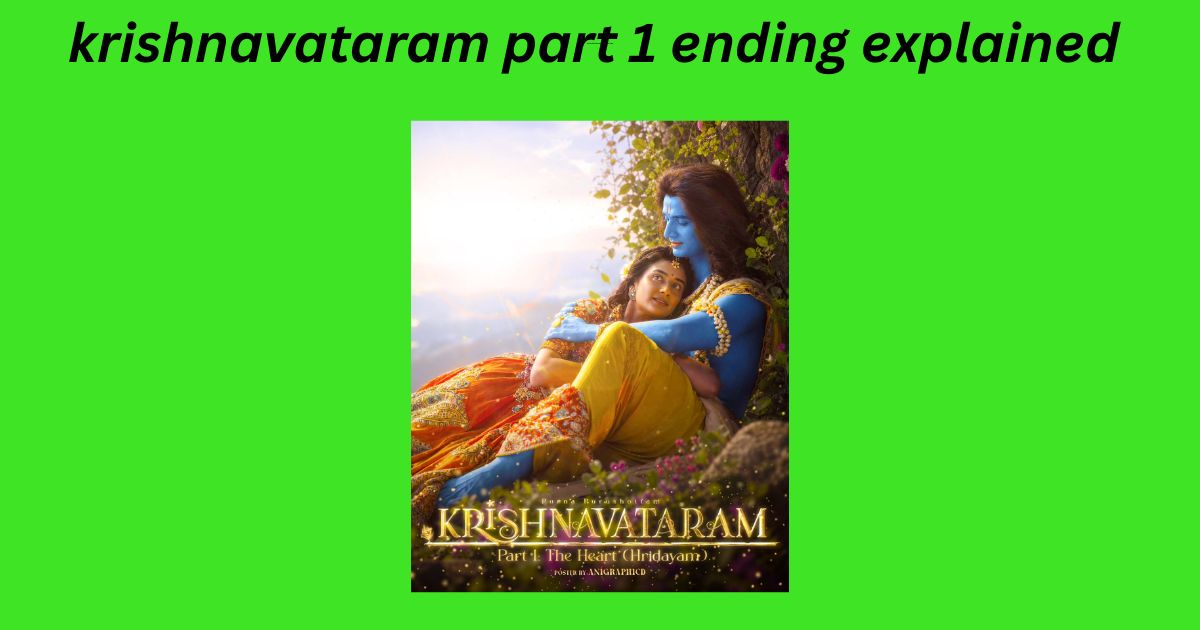
A Film That Feels More Like an Emotion Than a Movie
Some movies entertain you for three hours and disappear from your mind the next morning. But krishnavataram part 1 ending explained The Heart (Hridayam) stays with you quietly. Even after leaving the theatre, you keep thinking about Krishna’s smile, Radha’s pain, and that haunting ending that feels peaceful and heartbreaking at the same time.
Honestly, I went into this film expecting another grand mythology drama filled with CGI battles and loud dialogues. But what surprised me was how emotional and personal the storytelling felt. The movie doesn’t try too hard to show Krishna only as a god. Instead, it presents him as someone carrying love, sacrifice, destiny, and pain all together.
And that final scene… yeah, it leaves many viewers confused.
So here’s my detailed article where we break down the story, hidden meanings, symbolism, and what the film is actually trying to say.
The movie begins in a very unusual way.
Instead of directly showing Krishna’s childhood, the story opens near the end of his earthly life. Krishna has already been struck by Jara’s arrow and exists between life and death. That opening scene itself tells us this isn’t going to be a straightforward mythology film.
From there, the narrative shifts into a modern-day timeline where a young man questions the existence of God inside the Jagannath Temple. A priest then begins narrating Krishna’s journey.
Most of the film focuses on Krishna’s emotional relationships especially his bond with Radha and Satyabhama. The film shows Krishna not just as a divine warrior but as a man constantly sacrificing his personal happiness for duty.
We see:
- Krishna leaving Vrindavan behind
- Radha accepting separation as destiny
- Satyabhama struggling to understand Krishna’s emotional distance
- Krishna carrying the burden of protecting dharma while losing pieces of himself
The movie is less about action and more about emotions. At times, it actually feels like poetry.
That’s why the ending hits differently.
The final moments of Krishnavataram Part 1 are deeply symbolic.
In the climax, is shown reflecting on his journey after years of sacrifice, war, love, and separation. The film slowly reminds us that despite being divine, Krishna still experienced human emotions loneliness, grief, longing, and emotional exhaustion.
The most important part of the ending is Krishna’s acceptance.
He knows his earthly role is ending.
There’s a calmness in his face during the final scenes that almost feels beyond human understanding. The movie suggests that Krishna was never attached to power or victory. Everything he did was part of a larger cosmic balance.
And that final transition scene where the visuals become softer and almost dream-like — represents Krishna moving beyond the physical world.
But emotionally, the ending is really about separation.
Radha and Krishna never truly unite in a worldly sense. That’s the tragedy at the center of the story.
The film quietly tells us that real love is not about possession. It’s about spiritual connection.
That’s honestly what makes the discussion so emotional among viewers.
The Hidden Meaning Behind Radha and Krishna’s Separation
One thing I personally loved about the film is how it handles Radha.
Most mythology adaptations reduce Radha into just a romantic character. But here, she represents something much deeper.
Radha symbolizes the human soul.
symbolizes divine consciousness.
Their separation throughout the film is actually symbolic of humanity’s constant longing for spiritual connection.
There’s a beautiful sadness in that idea.
The movie repeatedly shows moments where Radha and Krishna are emotionally connected even when physically apart. That’s intentional. The film wants viewers to understand that spiritual love doesn’t depend on physical presence.
In many ways, the ending suggests that Krishna belongs to everyone, which is why he can never fully belong to one person.
It sounds painful, honestly. But also strangely beautiful.
Why the Film Feels Different From Other Mythology Movies
Most modern mythology films focus heavily on spectacle. Huge battles. Loud background music. Constant visual effects.
But Krishnavataram Part 1 spends more time exploring emotions.
Sometimes the pacing becomes slow, yes. A few scenes definitely feel stretched. But I think the director intentionally wanted viewers to sit with the emotions instead of rushing toward action sequences.
The silence in many scenes actually says more than the dialogues.
Especially during Krishna and Radha’s moments.
There’s one scene near the end where simply looks toward the horizon without speaking. That small moment probably explains his emotional burden better than pages of dialogue could.
And honestly, that scene stayed with me longer than the action scenes.
Symbolism and Hidden Details You May Have Missed
The Use of Light
Throughout the film, Krishna is often surrounded by soft golden lighting.
But near the ending, the lighting becomes pale and calm.
This visually represents detachment from the material world.
The Flute Symbolism
flute is not just a musical instrument.
It represents spiritual calling.
Whenever the flute appears, characters emotionally react without fully understanding why. The movie uses the flute almost like a bridge between the divine and human worlds.
And in the final scenes, the reduced use of flute music subtly hints that Krishna’s earthly chapter is coming to an end.
The Modern-Day Storyline
Some viewers found the modern-day questioning scenes unnecessary.
But I think the film uses them to connect ancient spirituality with today’s generation.
The doubtful young man represents modern society logical, skeptical, emotionally disconnected.
The priest’s narration slowly transforms his understanding.
In a way, the movie asks viewers to stop seeing Krishna only as mythology and instead understand the emotional philosophy behind his story.
My Personal Thoughts on the Ending
I’ll be honest.
The film is not perfect.
A few visual effects look unfinished, and some emotional transitions feel abrupt. But despite all its flaws, the movie has sincerity. You can feel that the creators genuinely wanted to tell Krishna’s story with devotion rather than just commercial spectacle.
And the ending really worked for me.
Not because it was shocking.
But because it felt peaceful.
There’s a strange emotional heaviness in watching a character who carries the pain of an entire world while quietly accepting his fate.
That final expression on Krishna’s face almost feels like forgiveness for humanity, for destiny, and maybe even for himself.
The ending strongly suggests Krishna’s earthly journey is ending after Jara’s arrow incident. However, the film presents it more as spiritual transcendence than death.
Why are Radha and Krishna separated in the film?
Their separation symbolizes spiritual love beyond physical attachment. The movie uses their relationship to represent the soul’s longing for divine connection.
Yes, the movie is planned as part of a larger trilogy. The next chapter is expected to explore deeper philosophical and political aspects of Krishna’s life.
Final Thoughts
At its core, Krishnavataram Part 1 is not just about mythology.
It’s about love that cannot stay, destiny that cannot be escaped, and faith that survives even through separation.
The movie may divide audiences. Some viewers wanted more action, stronger VFX, or tighter storytelling. But emotionally, the film succeeds in creating something surprisingly heartfelt.
And maybe that’s why the ending lingers in the mind.
Not because it gives all the answers.
But because it quietly asks us emotional questions we’re still thinking about long after the credits roll.
That’s the real beauty behind the discussion.
